Minimalist Decor for ADHD: A Practical Guide
Table of Contents
- How Visual Clutter Affects ADHD Brains
- Can Minimalist Decor Help ADHD Symptoms
- How to Organise Your Home with ADHD
- ADHD-Friendly Storage Solutions That Actually Work
- Reducing Visual Clutter for Focus and Mental Clarity
- Budget-Friendly Sensory Design and Zoning for Tasks
- Minimalism vs. Maximalism for Neurodivergent Brains
- Frequently Asked Questions
Last Updated: September 25, 2026
How Visual Clutter Affects ADHD Brains
Visual clutter creates real problems for people with ADHD, making minimalist decor a great practical solution. When your brain struggles with executive function, extra visual information becomes noise. Every item in your field of vision competes for attention. Your brain has to work harder to filter what matters and what doesn't.
Neurodivergent brains process visual information differently, and too many colours, patterns, and objects trigger cognitive overload, exhausting mental resources before your day even starts.
A cluttered room is like having ten browser tabs open at once, your brain processes everything simultaneously instead of settling on one task. Reducing visual clutter directly supports how your ADHD brain actually works.
Can Minimalist Decor Help ADHD Symptoms
Minimalist decor helps ADHD symptoms by reducing sensory overload. When you remove unnecessary items, your brain uses less energy processing your environment, freeing mental resources for tasks that matter.
Executive function requires mental energy. When your surroundings demand constant attention, less energy remains for work, hobbies, or self-care. A minimal space supports you instead.
Minimalism is about intentionality, not deprivation. For neurodivergent brains, keep what serves you: fewer items, clearer categories, and more white space.
At Barkly Basics, we offer products designed for neurodivergent living. Our approach combines minimalist aesthetics with functional organisation. The Cleaning Schedule and Checklist takes the thinking out of daily routines. The Dishwasher Clean or Dirty Sign Magnet eliminates decision fatigue and guesswork. These products are environmental supports that reduce cognitive overload.

How to Organise Your Home with ADHD
ADHD organisation requires visual, obvious systems that need minimal executive function to maintain, not traditional methods that assume you'll remember where things go.
Functional Organisation Strategies
Group items by frequency of use: daily items within easy reach in your workspace, weekly items in accessible storage, seasonal items further away. This reduces decision-making.
Use clear containers with visual labels (pictures, colours, text) so your environment tells you where things are. The Drawer Clothing Categorisation Stickers turn a confusing drawer into an obvious system and is particularly great for kids.

Create zones for different activities. A work zone, a relaxation zone, a sleep zone. Each zone has only the items needed for that activity. When you move between zones, your brain shifts focus naturally. You're not fighting visual distractions from unrelated tasks.
The Role of White Space in Daily Focus
White space is breathing room for your brain. When your eyes land on a surface, they should rest, not search. White space means less filtering required.
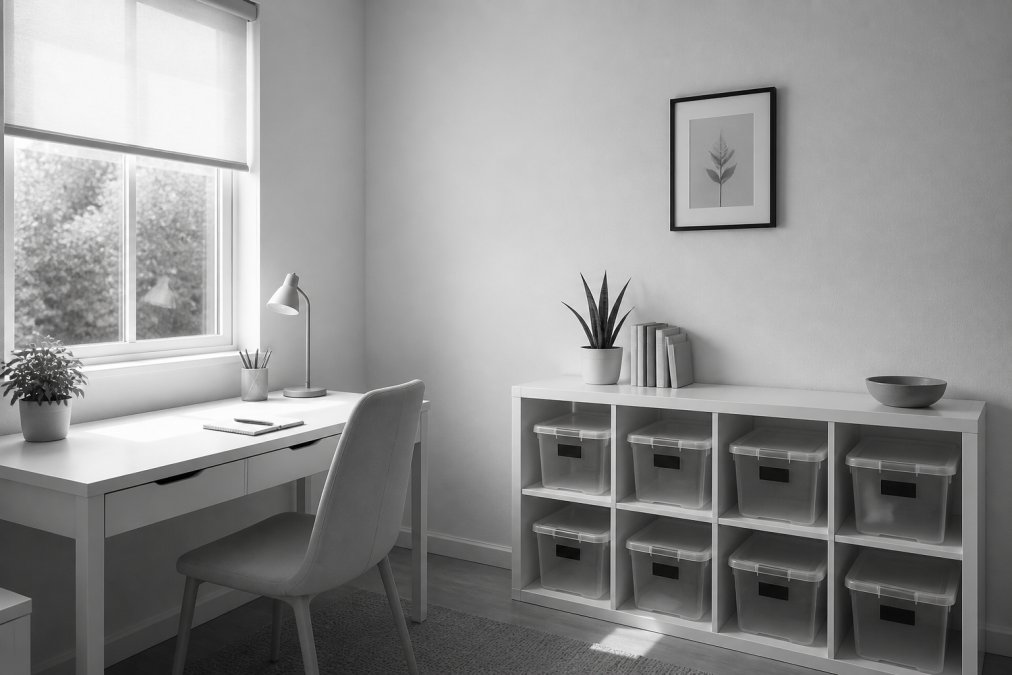
Empty wall space, clear desk surfaces, warm lighting and open shelving reduce information your brain must process. Minimalist decor helps ADHD symptoms because it's about mental energy, not aesthetics.
Aim for surfaces that are 70% clear and 30% functional items. This ratio feels balanced without being sparse. It gives your brain permission to relax while still feeling like home.
ADHD-Friendly Storage Solutions That Actually Work
ADHD storage must work with executive function limitations. Systems fail when they require too many decisions or steps, if you move three things to access one item, you'll abandon it within weeks.
Why Standard Storage Fails for ADHD Brains
Traditional organisation assumes reliable memory and consistency. Hidden storage creates a bigger problem: out of sight becomes out of mind, leading to duplicate purchases and wasted money.
Decision fatigue causes failure: overly specific categories ("winter scarves" vs. "summer accessories") create hesitation, which becomes avoidance, which becomes clutter.
Visible Storage with Broad Categories
Use open shelving or clear containers so you can see contents. Your eyes tell you what's available; your brain doesn't have to remember.
Keep categories broad: one "creative supplies" container instead of three, all socks together instead of by colour. Fewer decisions mean you'll actually maintain the system.
Label with both text and pictures, many ADHD brains process visuals faster than reading. Colour-coded labels add another visual cue layer.
The One-Step Rule
Access should require one action maximum. Keep frequently used items at eye level and within arm's reach. This difference determines whether you maintain the system or abandon it.
If your phone charger requires moving three items to access it, you'll leave it out. If it sits in a clear container on your desk, you'll put it back. Friction matters.
Cleaning Schedule and Checklist →
Real-World Examples of What Works
Clear drawer dividers for utensils, labeled baskets for items used together ("morning routine," "medications," "tech cables"), a single shelf for daily-use items, or a pegboard with tool outlines.
These work because they're visible, require minimal decisions, and tolerate imperfection.
Reducing Visual Clutter for Focus and Mental Clarity
Visual clutter impacts focus and stress. Remove items that don't serve a purpose, bring joy, or support your daily life.
Muted Colours and Sensory-Friendly Design
Muted colours (blacks, whites, greys, soft neutrals) create a calm foundation without requiring your brain to process colour information, supporting mental clarity.
Add colour sparingly through items you love, one piece of art, a plant, a few books, so they become focal points instead of visual noise.
Barkly Basics uses a black and white aesthetic because it's functional. Consistent colour schemes reduce visual processing energy.
The Dopamine Decor Counter-Argument
Some argue minimalism is too boring for ADHD brains and that dopamine decor, bright colours, patterns, novelty, provides helpful stimulation.
For under-stimulated brains, minimal spaces feel too quiet. Choose three items that genuinely excite you and display them prominently while keeping everything else neutral. Your brain gets needed stimulation without overload.
Dopamine decor is intentional; clutter is accidental. If items serve you, they belong. If they're just there, they don't.
Budget-Friendly Sensory Design and Zoning for Tasks
Minimalist design requires removing items you have and strategically using what remains. The real goal is sensory design that supports focus without under-stimulation or boredom.
Creating Task Zones Without Spending Money
Task zoning works because your brain uses environmental cues to shift focus. Moving between zones naturally transitions your brain between modes without conscious effort.
Create zones using furniture placement, lighting, or visual boundaries. A desk becomes your work zone; rotating your chair creates a reading zone. A fabric panel divides a room psychologically.
Use the same zone for the same activity every time. After a week, your brain learns the association, sitting at your work desk triggers focus automatically.
Sensory Layering: Beyond Colour
Texture: A soft blanket, textured rug, or fidget cushion provides tactile input without clutter and costs nothing if you use items you own.
Lighting: Harsh overhead lights increase sensory load. A desk lamp or natural light reduces strain. Warm light in relaxation zones signals calm.
Sound: Some ADHD brains need background sound to maintain attention. A fan, white noise app, or instrumental music provides gentle auditory input that masks distracting sounds.
Scent: A plant or baking soda with essential oil provides olfactory input. Lavender or chamomile in relaxation zones, peppermint or citrus in work zones. Cost: minimal.
The Dopamine Decor Balance: Stimulation Without Clutter
Some ADHD brains experience under-stimulation in minimal spaces and feel bored or unable to focus. This is a real neurological pattern.
If you're someone who thrives with stimulation, the solution isn't to abandon minimalism and return to clutter.
Low-Cost Sensory Hacks
Fabric draping: Hang a sheet or curtain to define zones or soften harsh corners. Cost: minimal.
Minimalism vs. Maximalism for Neurodivergent Brains
Minimalism works better for most ADHD brains because it reduces cognitive load. But minimalism isn't one-size-fits-all. Some neurodivergent people thrive with more visual stimulation.
Strategy |
Purpose |
Best For |
|---|---|---|
Clear containers with labels |
Visual organisation without memory |
Daily-use items and supplies |
White space on surfaces |
Reduces visual processing load |
Desks, shelves, walls |
Task-specific zones |
Supports focus and transitions |
Work, relaxation, creative spaces |
Muted colour palettes |
Calms sensory system |
Overall home aesthetic |
Visible storage systems |
Prevents out-of-sight forgetting |
Frequently used items |
Intentional item selection |
Removes decision fatigue |
Every category of possession |
Frequently Asked Questions
Can minimalism actually help people with ADHD?
Yes. Minimalist decor reduces visual clutter, which lowers cognitive load and sensory overload for ADHD brains. When there are fewer items competing for attention, executive function improves, and daily routines become easier to follow. A calm environment with white space supports focus and reduces decision fatigue, which is particularly beneficial for people managing ADHD symptoms.
How do I organise my home with ADHD without it feeling too bare?
The key is functional minimalism, not sterile emptiness. Keep only items that serve a purpose or bring genuine calm. Use a simple colour palette with black and white accents, add texture through natural materials, and personalise with a few meaningful objects. Tools like the Cleaning Schedule and Checklist or Drawer Clothing Categorisation Stickers from Barkly Basics add visual structure without clutter, making daily routines clearer and less overwhelming.
What are the best ADHD-friendly storage solutions?
ADHD-friendly storage uses clear labels, colour coding, and accessibility. Items should be visible and easy to reach, so you don't forget what you have. Magnetic signs like the Dishwasher Clean or Dirty Sign eliminate guesswork and reduce decision-making. Categorisation stickers help sort items logically. The goal is to make every item's home obvious, so executive dysfunction doesn't derail your routine.
Is minimalist decor more expensive than traditional home styling?
Not necessarily. Minimalism often costs less because you buy fewer items overall. Quality, purposeful pieces replace quantity. Barkly Basics products like the Cleaning Schedule ($16.95) and Dishwasher Magnet ($14.95) are affordable tools that support minimalist organisation. The long-term saving comes from avoiding impulse purchases and clutter accumulation, which benefits both your budget and your mental health.