How to Reduce Visual Clutter at Home
Table of Contents
- What Is Visual Clutter and Why It Matters
- How to Organize Your Home with ADHD
- Decluttering for Sensory Overload: A Calm Approach
- ADHD-Friendly Storage Solutions That Actually Work
- Managing Flat Surfaces and Creating Visual Rest
- The Role of Colour and Aesthetic Balance
- Maintaining Your Clutter-Free Space Long-Term
- Frequently Asked Questions
Last Updated: September 18, 2026
What Is Visual Clutter and Why It Matters
Visual clutter is the accumulation of objects and visual stimuli in a space that creates a sense of disorder and overwhelm. To reduce visual clutter effectively requires understanding these competing elements. It's not just about messiness, it's about how many competing elements demand your attention at once.
When a space contains too many objects, your mind works overtime. This sensory overload drains mental clarity, reduces focus, and can trigger anxiety.
For people with ADHD or sensory sensitivities, visual clutter is particularly challenging. An overstimulating environment makes it harder to locate items, maintain routines, and stay calm. Even small improvements in visual clarity can meaningfully reduce daily friction.
How to Organize Your Home with ADHD
Organising a home when you have ADHD requires systems that work with your brain, not against it. Start by identifying your biggest pain points, where things pile up or routines feel chaotic, then focus on those priority areas.
Use visual cues instead of memory. Labels, colour coding, and clear categories remove the need to remember where things belong. Tools like the Barkly Basics Drawer Clothing Categorisation Stickers make it obvious at a glance, no thinking required in particular for children.
Create zones for specific activities. Designate a spot for keys, incoming mail, and cleaning supplies. Each zone should have one clear purpose, reducing the mental load of deciding where items go.
Make the right choice the easiest choice. If a container is easier to reach than the floor, items go in the container. Design your space to make correct behaviour automatic.
Break tasks into micro-steps. Instead of "tidy the bedroom," the task becomes "put dirty clothes in the basket" or "clear the nightstand." Smaller steps feel less overwhelming and build momentum.
Decluttering for Sensory Overload: A Calm Approach
If you experience sensory sensitivity, decluttering isn't about speed or perfection. It's about creating a calming, predictable space.

Work in small bursts. Spend 15-20 minutes on one drawer or shelf. Stop before you feel tired. This prevents overwhelm and makes the process sustainable.
Reduce visual clutter first. Remove items with busy patterns, bright colours, or conflicting designs to reduce visual clutter. A space with fewer colours feels instantly calmer.
Sort by category, not location. Gather all similar items together. This makes it easier to see what you have and decide what to keep.
Create breathing room. Don't fill every shelf or drawer completely. Empty space is restful for your eyes and brain. It also makes items easier to find and retrieve.
Establish a "decision-free zone." Designate one shelf or drawer where items are pre-approved and never questioned. This removes ongoing decision-making about what stays visible.
ADHD-Friendly Storage Solutions That Actually Work
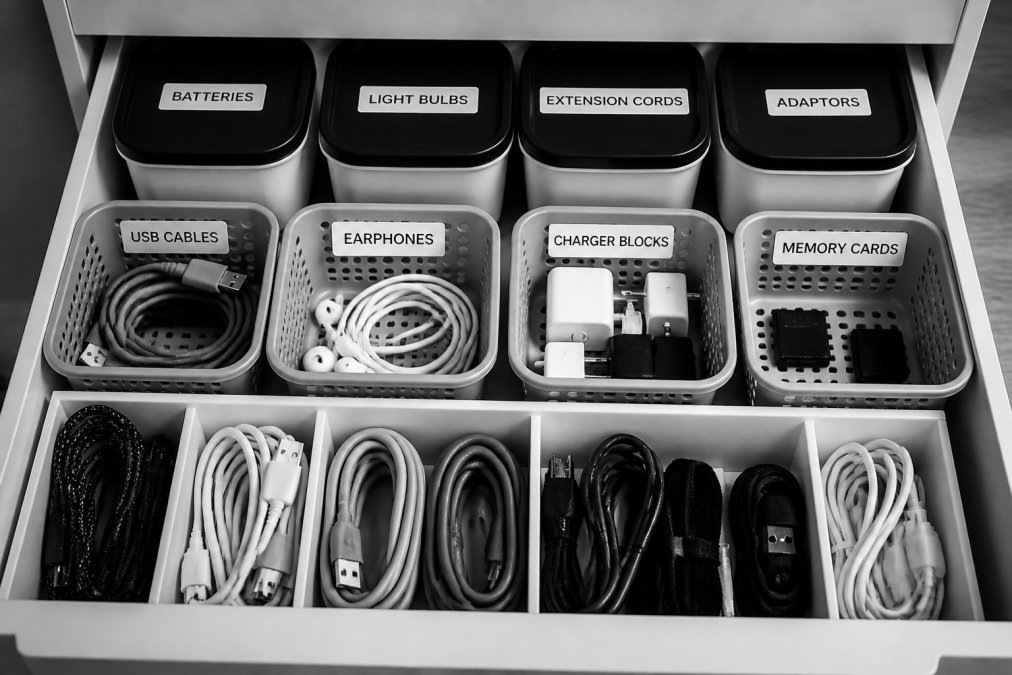
Enclosed storage is essential. Open shelving requires constant maintenance and forces decisions about what to display. Closed cabinets, drawers, and boxes hide visual complexity while keeping items accessible.
Use clear labels with large text. Labels should be easy to read from a distance. Handwritten labels in small print don't work. Printed, high-contrast labels (black on white) make it immediately obvious what belongs where.
Opt for uniform containers. Matching storage boxes, bins, and trays create visual harmony and make it easier to see at a glance whether a category is full or empty.
Keep frequently used items at eye level. Daily essentials should be within arm's reach and visible. This reduces the effort to locate items.
The Barkly Basics Black Silicone Decor Tray is designed specifically to contain bathroom or kitchen clutter in one visible, accessible spot. It keeps related items together, protects surfaces, and reduces visual scatter without requiring multiple storage solutions.
Cleaning Schedule and Checklist →

Create a "landing zone" near your entry point. This single location catches keys, mail, and daily items before they scatter throughout your home. A dedicated tray or basket prevents these items from creating visual chaos.
Managing Flat Surfaces and Creating Visual Rest
Flat surfaces, countertops, desks, nightstands, shelves, are where visual clutter accumulates fastest and has the most impact. Managing them requires both surface discipline and hidden infrastructure.
The rule: one purpose per surface. A kitchen counter should be for food prep, a nightstand for a lamp and book, a desk for work. When a surface has multiple purposes, it feels chaotic even if technically tidy.
Clear surfaces completely once per week. Remove everything, wipe down, and return only essential items. This resets your visual environment and prevents creep. Items that don't get returned are candidates for decluttering.
Use trays to contain related items. A tray groups similar objects (coffee setup, bathroom essentials, desk supplies) into one visual unit. Trays also make it easy to move a whole category at once if you need to clear the surface.
Minimise decorative objects. Choose fewer, meaningful pieces rather than filling shelves. A single plant or framed photo creates a focal point; ten decorative items create visual chaos.
Hide appliances and cords. Small appliances, cables, and chargers create disproportionate visual clutter. Exposed cords are one of the most common sources of visual noise in homes.
Create a dedicated charging station. Designate one location where all chargers and cables live. A small fabric organiser or cable box keeps everything contained and out of sight.
Reduce visual noise from technology. Hide routers, modems, and speakers in a closed cabinet or behind a screen. If visible, group them together as one unit.
Hide cords in plain sight. Fabric cable sleeves or cord covers make cables blend into their surroundings. A white cable sleeve on a white wall is nearly invisible.
Reset high-traffic areas daily. Spend 10 minutes each evening returning items to their zones. This prevents daily clutter from accumulating into overwhelming mess.
The Role of Colour and Aesthetic Balance
Understanding visual weight. Bright colours demand attention; neutral colours recede. A room with five bright accent colours feels chaotic; the same room with two colour accents feels intentional.
The monochromatic advantage. A monochromatic colour scheme uses one colour family in varying shades.
Maintaining Your Clutter-Free Space Long-Term
Creating order is one thing. Keeping it requires systems that persist without constant effort.
Frequently Asked Questions
What is the difference between physical clutter and visual clutter?
Physical clutter refers to actual objects taking up space; visual clutter is the visual noise these items create. You can have few items but high visual impact if they're mismatched, brightly coloured, or poorly organised. Conversely, a space can hold many objects but feel calm if they're hidden, cohesive, and organised. Reducing visual clutter often means grouping similar items, using enclosed storage, and maintaining a consistent colour palette—even if you're not reducing the total number of things you own.
How does visual clutter impact ADHD symptoms?
Visual clutter creates sensory overload for people with ADHD, making it harder to focus, initiate tasks, and manage executive function. When your environment has competing visual stimuli—multiple colours, exposed items, and visual noise—your brain works overtime to filter information. This increases decision fatigue and procrastination. A simplified, organised space with clear zones and hidden storage reduces this cognitive load, making it easier to locate items, start routines, and maintain focus. This is why ADHD-friendly design prioritises enclosed storage and visual simplicity.
How can a monochromatic aesthetic help reduce visual clutter?
A monochromatic or limited colour palette (such as black and white) reduces visual stimulation by eliminating colour competition. When everything shares similar tones, your eyes don't jump between conflicting hues, and the space feels more harmonious. This is particularly helpful for neurodivergent individuals and anyone with sensory sensitivities. A unified aesthetic also makes it easier to create visual hierarchy—important items stand out because they're intentionally placed, not because they're brightly coloured. This approach supports both visual calm and functional organisation.